

Gaoma safety | Overview and classification of respiratory protective equipment
Release time:
2023-09-20
Safety helmet as an indispensable personal labor protection products, plays the role of protecting the important head of the human body, plays an important role in safety production, its quality is related to everyone in the production.
Overview and classification of respiratory protective equipment
General situation
-- Protective equipment to prevent harmful gases, vapors, dust, smoke and fog from being inhaled through the respiratory tract or to supply oxygen or clean air directly to the dispenser, and to ensure the normal breathing of workers in dust, toxic pollution or anoxic environment, according to the protection method can be divided into two categories: filter type and isolation type:
Category I - filter respirator -
Concept of filter respirator
-- The principle of purification method is adopted to purify the toxic and harmful substances in the inhaled gas through the filter material, so that the wearer can obtain cleaner air
Classification of filter respirators
According to the source of power, it can be divided into self-priming filter and supply air filter respirators
According to the composition and status of the filter, it is divided into particulate matter (dust, smoke, fog) and gas (harmful gas, vapor) filter respirator
Ø Classification of filter respirators (according to power source)
Self-priming filter respirator relies on its own breathing to make the air containing toxic and harmful substances in the working environment pass through the filter;
Air filter respirators use electric or manual fans to pass the air containing toxic and hazardous substances through the filter in the operating environment
Ø Classification of filter respirators (according to the composition and state of the filter)
Particulate matter filters are divided into low-efficiency filters and high-efficiency filters according to their ability to remove particulate matter.
Gas filters are divided into low capacity filters, medium capacity filters and high capacity filters according to their removal capacity of harmful gases and vapors
Goma part of the respiratory products
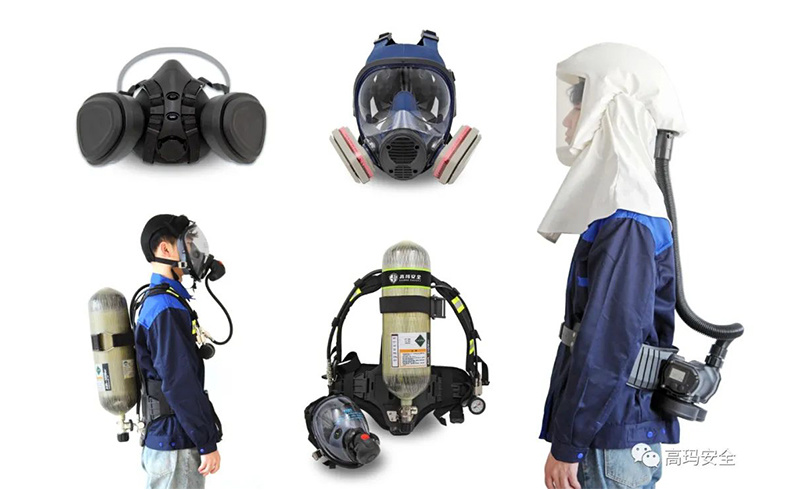
Limitations of filter respirators:
The characteristics of the filter material are related to the composition and physical state of the pollutant
This respirator should not be used in hypoxic environments
Nor does it protect against all pollutants
Self priming filter gas mask
Goma self-priming filter gas half mask 1900 series
Goma self-priming filter gas comprehensive 1608-DS series
(with call, amplification, drinking water function)
1. The main components of self-priming filter gas mask are mask and filter
2, the mask is divided into full cover and half mask according to the structure
3, according to the different filtration function, the filter is divided into ordinary (P), multi-function (D), comprehensive (Z) and special (T) filter four types
Ordinary (P) filter
Type A: Protective organic gas or vapor, brown
Type B: Protection against inorganic gases or vapors, gray
Type E: Protection against sulfur dioxide and other acidic gases or vapors, yellow
Type K: Protective ammonia and organic derivatives of ammonia, green
CO type: Protective carbon monoxide gas, white
Hg Type: Protective mercury vapor, red
Type H2S: Protective hydrogen sulfide gas, blue
Multifunctional (D) filters: Filters used to protect against two or more types of gases or vapors
Integrated (Z) Filter: ordinary or multifunctional filter with smoke filtering function
Special (T) filters: Filters for protection against gases or vapors specifically specified by the manufacturer
Filter protection time
Level 1: Protection time of general ability
Level 2: Medium protection time
Level 3: Advanced protection time
Level 4: Superior protection time
The smoke filtering performance of the integrated filter
P1: General capacity filtration efficiency
P2: Medium capacity filtration efficiency
P3: High capacity filtration efficiency
Self-priming filter respirator against particulate matter
1, according to the structure of the mask is divided into three categories: disposable mask, replaceable mask and comprehensive cover
2, filter components are divided into two categories according to filtration performance KN and KP:
Class KN is only suitable for filtering non-oily particles
KP type is suitable for filtering oily and non-oily particulate filter elements
Power supply Air Filter respirator (PAPR)
A filter respirator that relies on an electric fan to provide airflow to overcome component resistance.
PAPR is classified by mask type and pressure mode
Among them, PHF: positive pressure close type half mask, NHF: negative pressure close type half mask, PFF: positive pressure close type full cover, NFF: negative pressure close type full cover, PLF: positive pressure type open mask, PLH: positive pressure type air supply head cover.
Filter element classification
Class P: anti-particulate matter;
Class A: Prevent certain organic vapors with boiling point greater than 65 ° C specified by the manufacturer;
Class B: protection against certain inorganic gases specified by the manufacturer;
Class E: protection against certain acid gases specified by the manufacturer;
Class K: ammonia resistant and organic derivatives of certain ammonia as specified by the manufacturer;
Class NO: anti-nitrogen oxides;
Hg class: anti-mercury vapor;
CO: anti-carbon monoxide gas;
Class AX: Prevent certain organic vapors specified by the manufacturer with boiling point not greater than 65 ° C;
SX class: protection against certain special compounds specified by the manufacturer;
Any combination of the above categories.
Marking and coloring of filter elements
The filtration efficiency of anti-particle and integrated protective filter elements for particulate matter is 95.00% and 99.97%, corresponding to P95 and P100 labels respectively.
Class A, B, E and K anti-virus filter components are divided into three levels according to the protection capacity, level 1, level 2 and level 3 represent low, medium and high protection capacity respectively;
Other types of anti-virus filter components (such as: SX, CO, AX, NO, etc.) are not graded;
The classification method of A, B, E and K included in the integrated protective filter element is the same as that of its individual protective filter element.
Examples of PAPR filter element classification, color labeling, labeling and protection of contaminants
The second category - isolation respirator -
The concept of isolation breathing apparatus
The principle of the air supply method is used to provide a source of breathing air independent of the operating environment and to deliver breathing gas to the wearer through an air duct, hose or air supply (air or oxygen) device carried by the wearer
Classification of isolation respirators
According to the different ways of breathing air supply, it can be divided into air supply type and air carrying type breathing apparatus
Air supply breathing apparatus
Clean air is delivered through air ducts and hoses to isolate the wearer's respiratory organs from the surrounding air
According to the air supply mode, it is divided into self-priming type, continuous air supply type and high pressure air supply type long tube breathing apparatus
Self-priming long tube respirator
Electric supply air long tube respirator
Long tube respirator with high pressure air supply
Long tube respirator with high pressure air supply
Isolation breathing apparatus
The ventilator carries the air supply device by the wearer, so that the wearer's breathing organs are isolated from the surrounding air
According to the nature of the air source, it is divided into air breathing apparatus and oxygen breathing apparatus
Self-contained open circuit compressed air breathing apparatus
Self-contained closed circuit compressed oxygen breathing apparatus
Self-contained open-circuit escape air breathing apparatus
Self-contained closed circuit compressed oxygen escape breathing apparatus
Related News



Official Account

Website Mobile
Jiangsu Gaoma Safety Equipment Co., Ltd.
Tel:0086-519-83561818
Fax:0086-519-83561818
Address:Building 01, No. 258-19 Jinhua Road, Wujin Economic Development Zone, Changzhou City, Jiangsu Province
Website:www.czgaoma.com
Website:www.jsgaoma.com


